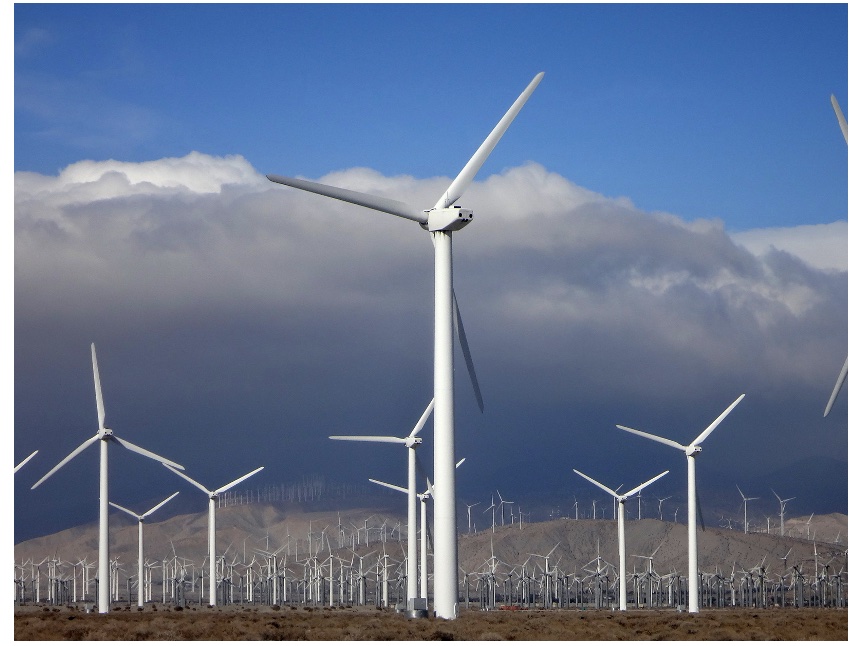
Source https://flickr.com/photos/20266194@N00/24110028330
While ignoring or negating the role of population growth, many environmentalists have pinned their hopes for controlling global warming on the implementation of new technologies. But is this really a viable approach?
Part I: The Scale of the Problem.
Reducing CO2 emissions and limiting global warming to 1.5-20C is a key goal for constraining man’s negative impacts on the environment. Much of the discussion on global warming has centered on the use of ‘green technologies’ such as wind and solar power to reduce dependence on fossil fuels and curb emissions. However, as we will explore in this and subsequent blog posts, there are several weaknesses in the plan to pursue technological approaches to limit global warming. In this post we will examine physical and financial constraints to the deployment of wind and solar power.
Physical Constraints on Renewable Energy.
The scale of the physical infrastructure required for the transition from fossils fuels to renewable energy is simply mind-boggling. An early estimate (1) utilized UN population projections and values for per capita energy use to calculate the amount of solar and wind installation needed to remain below 20C global warming. By 2100 13.7 million 5-Megawatt (MW) wind turbines and 652,000 km2 of solar panels (an area roughly the size of the entire country of Afghanistan) would be required. Panels and turbines would need replacement periodically, for example, about 700,000 new 5 MW turbines per year would be required. By comparison, in 2023 116 Gigawatts of wind energy was added globally (2) equivalent to about 23,000 5 MW turbines, or 30 times less than what is projected for climate stabilization. A more recent estimate from the McKinsey consulting group (3) estimated that solar panel installation would need to increase 8-fold and turbine installation 5-fold from current levels to be able to mitigate global warming. Thus, we are currently falling far short of implementing the basic generation capacity to transition from fossil fuels.
Another issue is that the variability of wind and solar means that renewable energy networks have accessory infrastructure requirements quite different from fossil fuel systems. Thus, extensive transmission networks must be constructed to redistribute power in response to changing weather conditions (4). An additional need is overbuilding of total installed capacity to have sufficient energy during periods when outputs are low. Finally, renewables will require extensive and costly power storage capabilities most likely in the form of batteries. For example, one estimate of the 2060 global need for battery storage for energy grids is about 3600 Gigawatt hours at a total cost of a trillion dollars (5). By comparison current grid scale battery storage is about 200 Gigawatt hours or 18 times less (6).
While the figures cited above are inevitably imprecise, clearly renewable energy infrastructure must be constructed on an enormous scale by 2050 in order to blunt global warming. This will require the use of massive amounts of raw materials such as steel and aluminum for turbines, copper for transmission lines, and lithium and other materials for batteries. Extracting and processing these materials will itself consume enormous amounts of energy and will doubtless cause substantial environmental degradation (7). Thus, the transition to renewables will be extraordinarily challenging simply on a physical basis.
Financial Constraints on Renewable Energy
The other key aspect of the renewable energy transition is financing. The massive new physical infrastructure needed will require equally massive amount of capital. Recent cost estimates are in the range of $3- 4 trillion annually, peaking in the period between 2030 and 2050 (8,9). The International Energy Agency has provided excellent data on this (https://www.iea.org/reports/net-zero-by-2050 ). In a more detailed view, in 2030 this would include $930 billion for power generation, $840 billion for transmission networks and $180 billion for energy storage (8). The 2023 total global investment in clean energy (of which renewable power was a major part) was about $1.75 trillion (10). To put these figures into perspective, $3.5 trillion is equivalent to about 50% of all corporate profits or about 25% of all tax revenue globally (11). Thus, on a percentage of GDP basis, the financial requirements of the renewable energy transition would be almost equivalent to those needed to fight WWII.
This post has outlined the physical and financial challenges facing the transition to renewable energy. In future posts we will examine other factors that have slowed progress, as well as the unintended environmental side effects of renewable energy investments. Meanwhile, the obvious solution to global warming, namely reducing global population, remains largely ignored.
References
- G.A.Jones,K.J.Warner: Energy Policy 93(2016)206–212
- https://wwindea.org/AnnualReport2023
- https://www.mckinsey.com/capabilities/sustainability/our-insights/the-net-zero-transition-what-it-would-cost-what-it-could-bring
- J. D. Jenkins et al: Joule 2 (2019) 2498-2510
- Y. Kaya et al: Sustainability Science 14 (2019) 1739–1743
- https://www.iea.org/data-and-statistics/charts/global-installed-energy-storage-capacity-by-scenario-2023-and-2030
- https://earth.org/lithium-and-cobalt-mining/
- https://www.energy-transitions.org/bitesize/three-key-policies-can-scale-1-trillion-investment-for-the-energy-transition/
- https://www.iea.org/reports/net-zero-by-2050
- https://www.iea.org/reports/world-energy-investment-2023/overview-and-key-findings
11. https://www.bloomberg.com/features/2024-net-zero-brutal-economics/
 EQUIPOISE
Leave a comment