Sometimes really smart (and very rich) people say really dumb things. One that irritates me to no end is Elon Musk’s ridiculous statement “population collapse due to low birth rates is a much bigger risk to civilization than global warming “. So, while Elon dreams of moving millions of his fecund acolytes to Mars, I guess the rest of us will be stuck here with a planet in terminal decline.

pexels-spaceX
Sure, it is true that in some nations fertility rates have dropped below replacement levels anticipating that populations will decline over the next decades. This has triggered cries about societal collapse as well as the growth of a rabid pro-natalist movement that seeks to induce or compel women to have more babies . Certainly, a rapid decline in a nation’s population will create significant problems. But just how devastating will those problems be, will smart policies be able to lessen their impact and are there any upsides to a declining population? Perhaps the best place to look for answers to these questions is Japan whose fertility rate and population have been declining for longer than any other major nation.
The Basics: The Decline of the Japan’s Population.
Current projections of Japan’s total population and working age population certainly look pretty grim (Fig 1 A,B). From a peak of about 120 million in the 2000s, Japan’s population will be about 100 million in 2050 and perhaps about 70 million by 2070. The ratio of working age people to total population looks even worse as rapid aging of the nation takes place, with a decline from approximately 60% working age in 2020 to 51% in 2060.
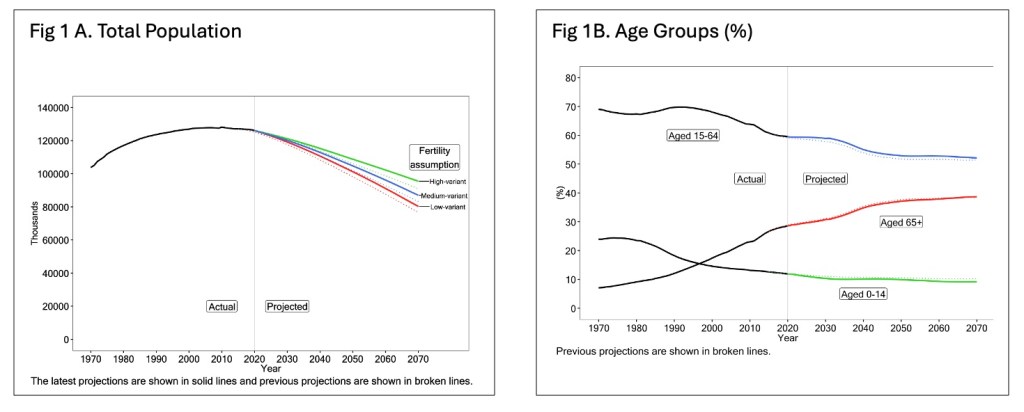
Taken from this source
These projections have raised the usual concerns about population decline. Namely, a reduced labor force needing to pay the pensions and health care of an increasing population of elderly, a reduction of services in depopulated areas, a loss of innovation with fewer youthful minds available, and a general slowing of the economy and erosion in the quality of life. But what has actually taken place thus far? Japan has been dealing with population decline for approximately two decades. To what extent are the doom and gloom scenarios valid?
What has Been the Impact of Two Decades of Population Decline in Japan?
To answer that question let’s look at some key statistics, particularly GDP per capita, household income, and longevity, as shown in Fig 2A-C.
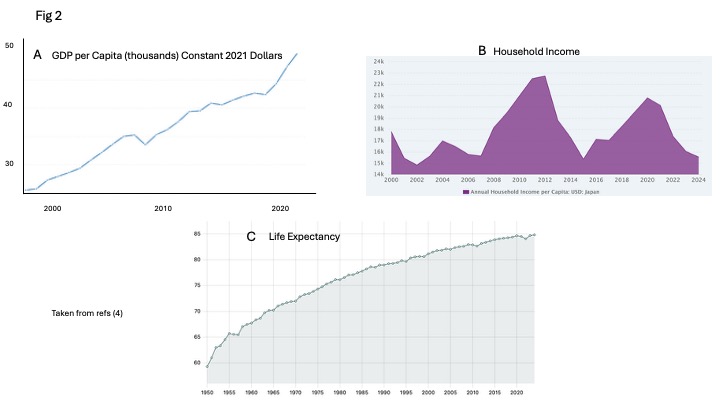
Aggregated from this source
Importantly, the key parameter of GDP per capita has continued to rise throughout the period of population decline. Since GDP is closely related to productivity which in turn is connected to innovation, at least so far, there is little sign of a lack of young minds leading to stagnation. There are many indicators of the general well-being of a population, but certainly two important ones are household income and health, particularly as manifested by longevity. Since the start of the population downturn Japanese household income has held up quite well. There have been peaks and valleys presumably corresponding to financial cycles, but no overall decline. Amazingly, longevity continues to rise rapidly even though some of the Japanese elderly are starting to push currently known boundaries for the human lifespan.
Thus, after two decades of population decline we find an economy whose productivity is rising, households with a stable standard of living, and pensioners who obviously must be receiving adequate, food, shelter and medical care to sustain their health to advanced old age. Does this seem like a calamity?
I do not wish to belittle the challenges inherent in rapid population decline. They are quite real. However, Japan’s experience thus far suggests that significant mitigation of the worst effects is possible. The Japanese government and indeed the entire society has been well aware of the impending population problem and has developed many policies and strategies to cope. Not all of these have been successful, but they are certainly worth examining.
Japan’s Responses to a Declining Population
Japanese society has responded to the challenge of a less numerous future in the following innovative ways, arguably laying a blueprint for other nations with declining birthrates (see much of Europe and Asia):
a. Society 5.0. This phrase encapsulates the Japanese government’s view of the future of the nation. It visualizes a society beyond the industrial era or the information era to “a human-centered society in which economic development and the resolution of social issues are compatible with each other through a highly integrated system of cyberspace and physical space.” The 5.0 vision incorporates rapid technological change, alterations in social organization, responses to environmental challenges, as well as dealing with Japan’s demographic issues. While the ultimate impact of this approach is unclear, it represents one of the few examples of a democratic government undertaking broadly-based long-term planning.
b. Industrial Technology. From 1980s to the early 2000s Japan’s tradition of“monozukuri” or dedicated craftsmanship led to its domination of high technology industries including automobiles and electronics. While many technology firms remain strong, Japan’s dominance has been eroded by new competitors particularly China and S. Korea. Additionally, the declining working age population has affected many industries. In response, Japan’s leading technology companies have incorporated robotics and AI to integrate production in novel ways. Japanese industry has a long history of employing robots, but the new strategies involve sensor-based quality control, predictive maintenance, digital twinning of devices and processes, and the integration of manufacturing with supply chains to seek major increases in productivity and quality. This approach also entails a reduced need for human input thus anticipating the decline in the working age population. While this transition to a new high-tech economy has been uneven, the overall approach is an important part of Japan’s strategy to deal with its demographic challenge.

pexels free image
c. Technology in Daily Life. An aspect of Japanese technology that has attracted media attention worldwide is the increasing use of robots and AI in everyday life. Building on the tradition of ubiquitous vending machines, Japanese merchants have increasingly opened ‘unattended’ stores where purchases are made in the absence of any store personnel. This started with food products but has extended to clothing and many other items. Purchases are made via smartphone apps and AI controlled sensors monitor customer activity and the positions of items for sale. Thus, sales are recorded accurately even if the customer returns some items to the shelves before completing the transaction. In the restaurant business a new approach is to use ‘avatar robots’ that are controlled remotely by a ‘pilot’ who may not be on the premises. The avatar can take orders, serve food or engage customers in conversation. Clearly a driving force behind these developments has been the desire to reduce the number of employees needed for routine service tasks by substituting with advanced technologies.

Taken from this source
d. Elder Care Technology. A major topic of concern in Japan involves the resources than will be necessary to care for an increasingly large geriatric population. The hope is that technology can substantially mitigate the problem. However, early attempts to introduce robotic assistants in nursing homes have not gone as well as hoped. In many cases instead of saving labor, the early generation robots needed staff to serve as ‘nursemaids’ thus adding to rather than reducing staff effort. We are all familiar with the cute and cuddly humanoid or animal-like robots that Japan has produced, some in the hope of providing emotional support for the elderly. However, in some cases even that has backfired with residents developing paradoxical or in appropriate relationships with the cuddle robot.
Nonetheless, lessons are being learned from early failures and currently a wide range of technologies are being pursued to assist in elder care. While increasingly sophisticated AI-controlled humanoid robots continue to be developed, much of the attention now addresses more prosaic approaches. This includes monitoring systems to track the well-being of the elderly, smart mobility-assist devices and robots for logistics support in hospitals and nursing homes. A feature of current strategies is the recognition that there are many economic, social and ethical challenges that need to be addressed as AI and robotics become a key part of geriatric care. Thus, despite setbacks, there seems to be an inexorable trend toward using technology to replace human labor in care of the elderly.
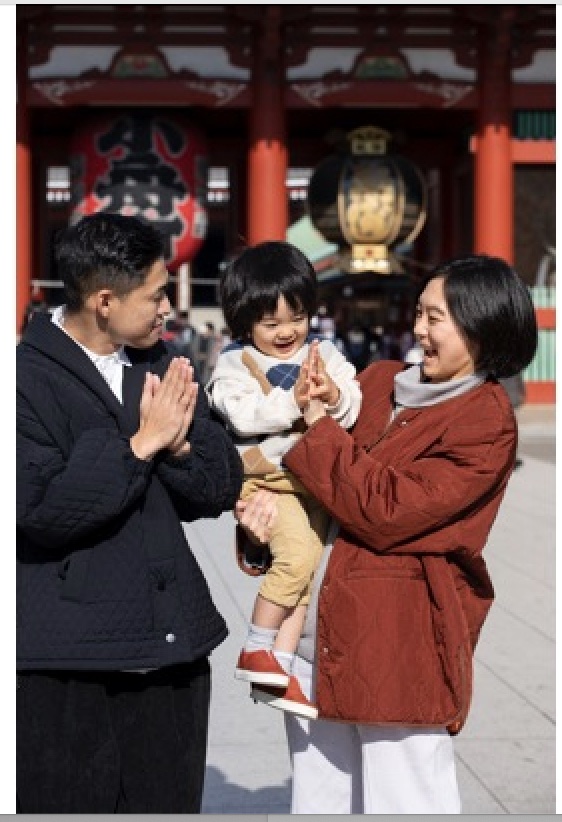
e. Support for Children. An important aspect of Japan’s response to a low birthrate is to increase support for children. The most direct actions are the provision of a childbirth lump sum and substantial monthly child allowances continuing to age 15. Additionally, a variety of pediatric health services are provided free of charge. However, it is widely recognized that simply boosting child allowances is not sufficient to alter population trends since life in Japan presents many obstacles for families. The Japanese government recognizes this and has set goals for many family- friendly policies including increasing the housing supply, provision of daycare centers, and changing the work-life relationship for both women and men. However, many challenges remain including entrenched attitudes about the role of women in the work force and in society, as discussed further below.
Freepik free image
f. Immigration. Historically Japan has been unwelcoming toward immigrants, but recently both policies and attitudes have changed substantially . For many years Japan’s foreign-born population hovered around 0.6% but by 2023 it had reached 2.7%, coming mainly from other Asian countries. Previously Japan had allowed some limited entry of unskilled workers, but often under exploitative conditions. Recently, however, several policy reforms have been implemented that encourage immigration of skilled workers and especially of scientists and engineers. Interestingly, at least until very recently, the increased presence of immigrants has not sparked the sort of hostility and right-wing populism that has taken place in Europe and the USA. Most Japanese seem to accept that immigrants are needed to fill gaps in the labor pool. However, both the difficulty of learning the Japanese language and the complex social norms of the nation have impeded the integration of immigrants into society
As outlined above, Japan has sought to address the depopulation issue using multiple approaches. However, the effectiveness of these approaches remains unclear. The section below will examine some if the impediments to Japan’s strategy to blunt population decline.
Challenges ahead
A significant factor in Japan’s population decline is the low number of marriages, particularly since births out of wedlock are rather rare. Young Japanese are reluctant to marry for a variety of reasons including job insecurity and lack of affordable housing. Additionally, surveys indicated an unwillingness among men to assume household responsibilities, while women cited concern about losing their freedom and balancing working and personal life. Thus, a significant portion of people in their 20s and 30s (14 to 25% depending on age) want to remain single. Part of the problem is the entrenched attitudes of corporate working life including the classic ‘salaryman’ culture that requires unremitting commitment to work as well as liquor-lubricated socializing with colleagues after hours. This makes it very difficult for Japanese women to combine a successful professional life with family responsibilities.
While employment among women has rapidly trended upward in recent years, significant barriers remain. Thus, work force participation, percentage of women in leadership roles, and equality of compensation between males and females have lagged other developed nations, while the percentage of women in non-regular employment (as opposed to lifetime ‘salaryman’ jobs) is very high. Thus, despite Japan’s generous approach to parental leave and support for children, marriage rates and birth rates remain low. Fully or partially reversing current negative attitudes toward marriage will be very challenging but nonetheless is an extremely important part of seeking to blunt population decline.
As mentioned above, in recent years Japan has been more welcoming to immigrants as a way of expanding its labor force. However, very recently some backlash to this approach has developed. There has been a rapid rise in the number of foreigners residing in Japan as well as in the flow of foreign tourists. The increased numbers and the fact that many foreigners are not aware of Japan’s cultural norms have increased friction. Additionally, crimes committed by foreigners are often played up in the press leading to further concern among the native Japanese. Finally, wealthy foreigners, primarily from China, are apparently driving up the price of real estate. The new Takaichi government has tried to balance a more aggressive prosecution of crimes committed by foreigners, as well as of real estate speculation, while continuing to welcome foreign workers. It remains to be seen how this will work out.
Possible Benefits of a Declining Population
A declining population is not all bad news. One obvious potential benefit is a reduced impact on the environment. Thus, Japan’s CO2 emissions from combustion declined by 18% from 2000–2023, while the goal is a 70% reduction from 2013 levels by 2040. Certainly, use of more efficient energy sources contributes to these changes, but it is also sure that fewer people mean less use of resources.
Another possible benefit is ‘re-wilding’ of rural areas that had previously been used for farming or for habitation. However, there is some controversy about this topic. Some studies have shown a substantial expansion of the range of wildlife, especially larger animals, as the rural population declines. This is consistent with many anecdotal reports about increased human-wildlife interactions. In contrast, a very thorough recent study found that biodiversity was not increased in areas of declining population in Japan but rather that population stability contributed to biodiversity. Thus, currently there is an incomplete picture of the connection between population decline and impacts on wildlife.
Finally, a declining working age population will clearly compel Japan to make better use of all segments of society. Thus, it seems likely that there will be more opportunities for women and a reduction in the restraints on women’s careers that were discussed above. A greater participation of the elderly in the workforce is also likely, as not only the lifespan but the ‘healthspan’ increases and as rigid ideas about age of retirement become more flexible.
Avoiding catastrophe
Over the next few decades many developed nations will experience declining populations. For some people, this seems like an existential threat thus sparking the need for radical pro-natalist strategies to increase the birthrate. However, learning from the Japanese example, we can see that population decline is not necessarily a disaster. Given a long enough time horizon, carefully crafted policies along with technological innovation can blunt many of the negative aspects of a reduced population. There are even some potential benefits to be gained, for the environment, and for people who are currently somewhat marginalized in society.
Personally, I am glad that my children and grandchildren will live in a world with a declining population. Over the last few decades, the explosive growth of human numbers has brought us to the verge of environmental catastrophe. As our numbers shrink perhaps nature will finally be able to heal itself.
Thanks for reading.
Epitteto is a biomedical scientist with a long academic career now interested in the complex connections between the environment, population and technology.
See this post and others by Epitteto on MEDIUM.
 EQUIPOISE
Leave a comment