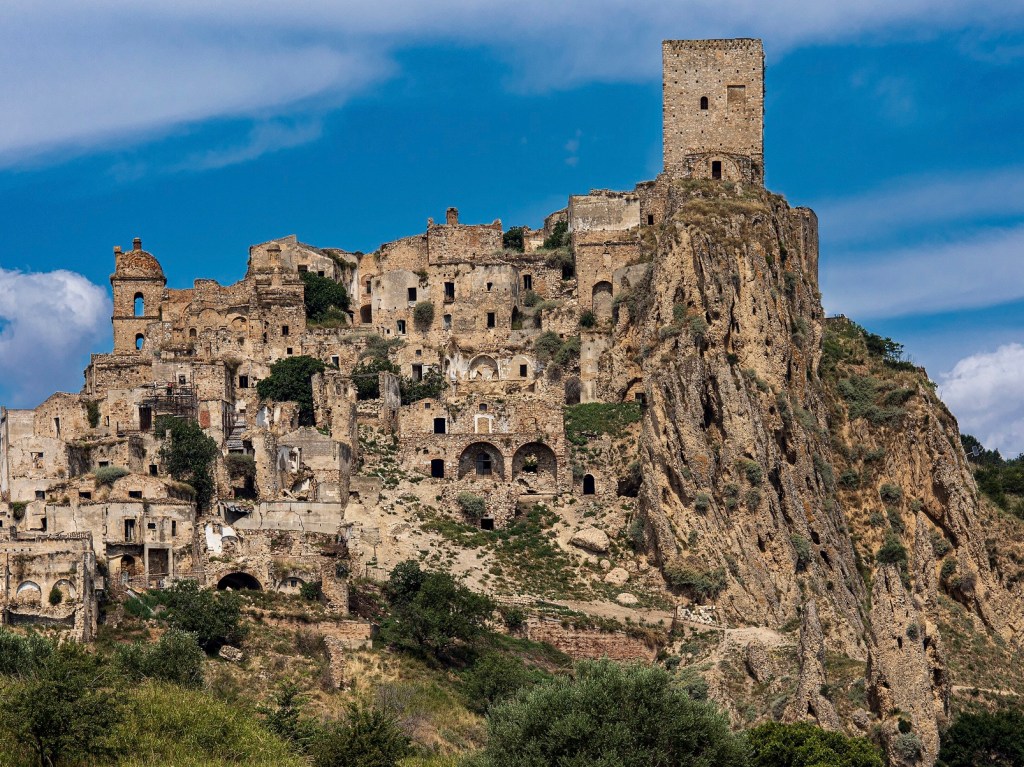
Image of Craco, Basilicata Italy. Source Wikipedia Commons.
The public bus from Catania to Enna rolls past the rich farmlands of coastal Sicily, smoke rising from the massive cone of Mt. Etna in the distance. Ahead lie the hills and mountains of central Sicily, dry, harsh and forbidding. I am living my dream of traveling through the less touristed parts of Italy, using local trains and buses to go from Milan to Palermo, with many delightful stops between. There is no such thing as a tourist-free town in Italy, but in some out of the way places tourists were scarce and my modest ability to converse in Italian proved useful. As we approach the ancient fortress city of Enna perched on its lofty cliff, the countryside becomes more and more desolate with withered fields, broken stone walls, and small villages that seem empty or asleep. Arriving at Enna offers some relief; despite its pre-Roman origins, Enna is a modern and seemingly prosperous town. However, an early evening walk on the Bellevedere, a lovely promenade that skirts Enna’s steep cliffs, allows a sweeping view of the landscape of central Sicily and confirms the sense of desolation and decline.
The Problem
The depopulation of rural villages in Italy has been widely reported, with the ‘one euro house’ as a potent symbol of the entire complex problem. The emptying of small towns is linked to the larger issue of declining birth rates in Italy as a whole, and indeed in much of Europe. Thus, the current total fertility rate in Italy is 1.14 children per woman, one of the lowest in the world. However, the problem of population loss is especially acute in smaller towns and villages, particularly in the ‘Mezzogiorno’, the historically poorer region of Italy from Naples south. A combination of lack of economic opportunity, political stagnation and entrenched crime has led to an efflux of young, energetic people to the more dynamic cities of northern Italy or to other countries. The resulting shrinking and aging of the remaining population has resulted in schools, businesses and public services closing and a breakup of community traditions. The chart below shows the unevenness of population decline in Italy, with the south of the peninsula as well as Sicily and Sardinia demonstrating the greatest losses.
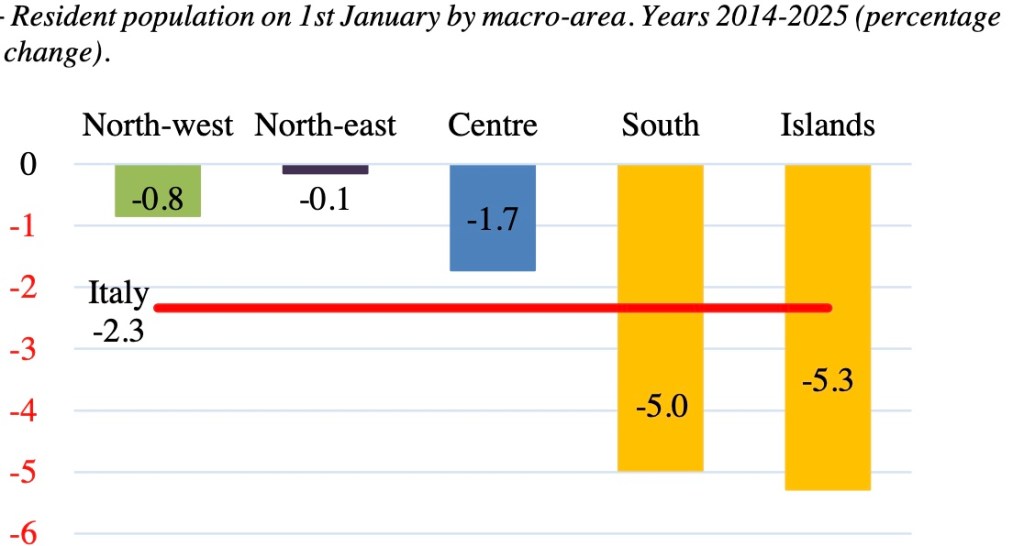
Taken from this source.
The shrinking population in the Mezzogiorno reflects its lack of economic opportunity with respect to other regions of Italy. For example, the unemployment rates in Calabria and Sicily are 12.4 and 12.1 percent compared to 3.3 in Lombardia where Milan is located, while similarly the poverty rate in Calabria is 32.2 percent versus 9.2 percent in Lombardia.
But the dry statistics fail to capture the personal tragedies as well as the loss community and cultural traditions that have accompanied the hollowing out of rural villages in Italy. A story in the Guardian that epitomizes the situation describes Pagliara dei Marsi, a little town in the Abruzzo region of southern Italy that just celebrated the first birth of a child in 30 years. Similarly, a writer living in the same region states: “It’s strange and, in a way, a bit heartbreaking, seeing how the town used to be. You hear the older folks talk about how areas that now sit vacant were once vibrant with life, with neighbors out on the streets chatting and kids playing everywhere“. In Piazzone, in the Molise province, a traditional religious festival that involved carrying statues through town has been limited by the lack of young men strong enough for the task. Even language is threatened, as depopulation erases the memory of unique regional dialects.
Government Policies
The long-standing downward trend in fertility has prompted the Italian government to modify its social welfare policies, placing more emphasis on child-rearing and in particular on families with more than one child. For example, mothers with two or more children are exempted from social security. Additionally, parental leave policies have been expanded with 80% of tax-free pay available for 5 months for women and 100% for 10 days for men. The government also supports day care subsidies of up to 3600 euros for lower income families. Perhaps the strongest component of government policy is the General Family Allowance (GFA), a 20-billion euro program that provides direct stipends to parents irrespective of their financial or employment status. The amount of the stipend is however, income adjusted with the maximum amount of 175 euros monthly available to about 50% of the population but reduced for higher income families. These policies have only been implemented in the last few years and thus their impact on Italy’s overall population trajectory remains to be determined.
In addition to national level programs there have been efforts focusing specifically on the decline of rural communities. Thus 21 villages are receiving 20 million euros each from the central government as part of a European Union post-Covid recovery plan. Individual regions and municipalities have also promoted population growth. For example, the provincial governments of Sardinia, Calabria and Emilia-Romagna have each provide substantial payments to people willing to move to rural towns. However, these programs have stringent requirements involving citizenship or duration of residence that make access difficult.
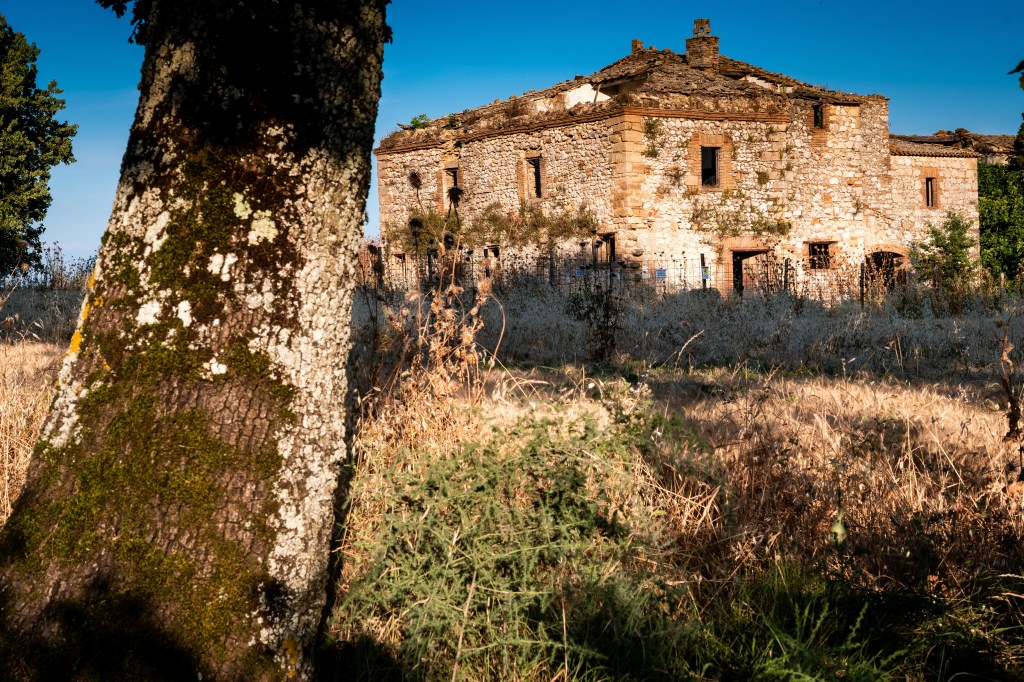
Abandoned rural house. Photo by Bruce Kee on Unsplash.
The Italian government’s current pro-natal programs have been criticized on several grounds. Thus, while an improvement on the past, the newer programs still fall short of what is provided in some other European countries and may simply be too modest to have a large impact. Additionally, the recent stagnation of the Italian economy means that young people who are prospective parents often either migrate abroad or substantially delay starting a family until they achieve some degree of financial stability. Another criticism is discrimination against non-traditional families, including criminalization of the use of surrogacy. Finally, the government has been accused of undercutting its own policies by trying to centralize public services such as schools, hospitals and transportation so as to be ‘cost effective’, but by doing so undermining the stability of smaller communities.
Local Initiatives
While large-scale government programs certainly play a role, some of the most successful efforts countering the depopulation of rural communities have come from the communities themselves. Building on a Covid era trend of reverse migration from cities to rural areas, a number of communities have established themselves as remote working ‘hotspots’. For example, in Tuscany the town of Santa Fiore has provided inexpensive fiber optic connections as well as reduced rent for internet savvy new inhabitants. An interesting historical sidelight on the Covid-induced urban to rural surge is a parallel migration that occurred in Italy in the 14th century due to the Black Death that led to Boccaccio’s classic work The Decameron. For more on the Black Death and its impact on population and economics see this source. Getting back to the present, other towns have capitalized on their lower rents and better quality of life to attract young families. Thus, the town of Pelago has seen its population grow substantially over the last few years, driven in part by the extremely high cost of living in nearby Florence. These efforts have even resulted in a partial offset of the ‘brain drain’ of well-educated young Italians leaving the country; instead, an increasing number have returned to Italy, taking advantage of remote working to keep connected to overseas employers.
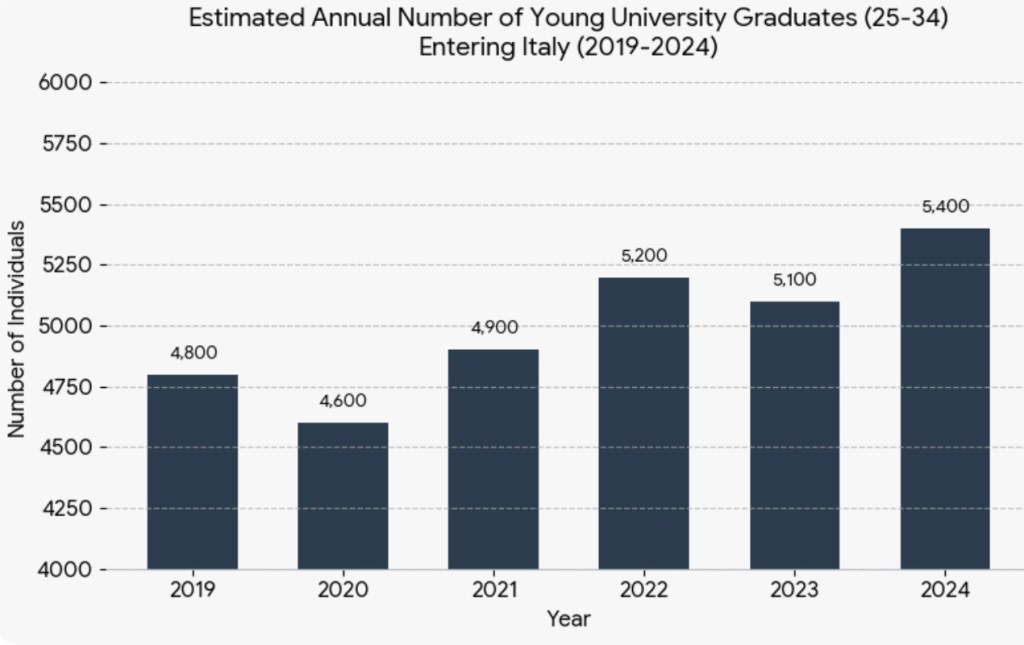
Taken from this source.
However, strategies that work in small towns near large metropolitan areas may be less effective in the remote villages of the Mezzogiorno. There a key approach has been to welcome non-Italian immigrants into the community. For example, the Calabrian town of Camini had seen its population drop precipitously in the 1990s, but has experienced a revival as immigrants from countries as diverse as Syria, Bangladesh and Turkey join the community. Over 100 small towns are participating in a Calabrian government sponsored program that assists in the integration of new immigrants, while similar programs also exist in Sicily. The influx of new residents has been beneficial in many ways, particularly via an increase in activities such as agriculture and trades. However, there are limitations to this approach as well. Thus, the current national government under Georgia Meloni has severely limited unauthorized migration, although it has also established predictable entry quotas for non-EU workers in key areas like agriculture, care-giving and tourism. At this point it is not clear how the transition from primarily unauthorized to primarily legalized immigration will affect re-population efforts in rural communities.
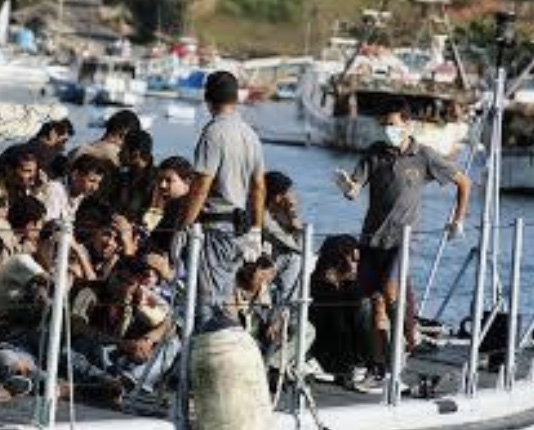
Refugees arriving at Lamedusa, Sicily. Photo by Sara Prestianni / Noborder Network via Wikimedia Commons.
Benefits of a Reduced Population
Although the depopulation of rural villages in Italy has clearly caused major economic disruptions, there have also been some, often surprising, benefits. One mentioned above is that former urbanites are finding a more relaxed life style and greater community integration after moving to a small town. Another very important benefit is the positive impact on local ecology. Thus, in much of the Mezzogiorno, centuries of overgrazing and poor agricultural practices led to the degradation of vast areas of the landscape. However, as a result of rural depopulation, many areas are now returning to native grassland and forest including economically valuable species such as silver fir. This extensive local re-wilding also has a broader impact in that carbon capture is greatly increased as compared to degraded agricultural land. A fascinating historical parallel is that the depopulation caused by the Black Death in the 14th century led to extensive forest regrowth across Europe, similar to the case in Italy today.
It is interesting to compare the experiences of Italy with those of Japan, another major nation that is impacted by a declining fertility. A reaction common to both nations has been to increase the scope of government programs designed to assist families with children, although the effectiveness of those programs in promoting fertility is currently unclear. A notable difference is that Japan has enthusiastically embraced technology as a way of offsetting the labor shortages associated with a reduced population whereas there has been less emphasis on technology in Italy. Finally, both nations have seen major changes in the rural landscape as declining populations in small towns lead to forest growth and re-wilding.
Summary and Analysis
What then can be learned from Italy’s experience with declining birth rates and the threat of depopulation at both the local and national levels? Are there glimmers of hope for the future?
Regarding the re-population of small towns, one aspect that stands out is that local efforts often seem to have done better than massive programs from the central government. Thus, as mentioned above, a number of small Italian towns have reversed their population declines via innovative approaches suited to their unique situations.
Contemporary information technology is likely to play a determining role in the fate of small Italian towns and indeed of the entire Italian economy. While the vast expansion of remote work initiated by the pandemic has subsided considerably, it remains an important possibility that allows people to live in small towns and still participate in the modern world. Thus, the availability of remote access, coupled with lower costs of living and many positive quality-of-life factors, may promote growth in small towns through in-migration and even possibly through increased fertility.

The looming impact of AI is a major concern for the entire global economy, but almost paradoxically Italy, an economic laggard on many counts, may fare better with AI than more advanced economies. Much of Italy’s economic output comes from small to medium businesses that provide unique, high-quality products. While some businesses have been undercut by cheaper imitations, there remains a strong demand for quality. Thus, the artisanal cheese producer or the maker of high-quality leather goods may see less impact of the AI/robotics duality than will mass production businesses. The availability of stable employment is always,a key determinant of family formation and thus a reduced impact of AI on jobs may be a positive factor for Italy’s future fertility. That said, Italy is not ignoring the AI revolution and indeed is striving to become a European AI powerhouse.
Finally, the vast sweep of Italy’s history, its magnificent scenery and its depth of art and culture remain an attraction for people from around the world. However, the various permutations of the ‘one euro house’ programs have been only partially successful in bringing new full-time residents to underpopulated small towns. To really have an impact these programs need to be more accessible to young Italians who want to start a family, rather than mainly to older, richer foreigners. That would require a major reduction in the bureaucracy and other impediments involved. Nonetheless, these programs do point in the right direction as a tool for re-population of smaller communities.
Thus, the overall picture regarding population trends in Italy is rather complex. At the local level there has been some progress, as small towns deploy increasingly sophisticated methods to attract new residents. At the national level, government sponsored pro-family programs have yet to have a significant impact on the total fertility rate, but the newness of these programs makes evaluation difficult. Currently Italy’s total population is stable as immigrants fill the gap caused by reduced fertility but changes in the government’s immigration policies could affect that. Finally, the nascent AI revolution is a wild card for all nations. It remains to be seen whether Italy’s complex economy of small-scale producers will be affected to a greater or lesser degree than other nations.
In the global context there may be two lessons to be learned from Italy’s experience. The first is that a reduced population in rural areas can bring ecological benefits, as nature reclaims unproductive fields and pastures for new wilderness. The second is that reduced fertility is largely a consequence of economic barriers to family formation and that such barriers can be mitigated by government policy and by economic opportunities. Thus far, Italy has seen more success at the local level than the national one, with some small towns regaining population through innovative pro-family approaches.


Leave a Reply